

How To Change Your Privacy Settings
You've been told over and over that Windows 10 is the all-time thing since MS-DOS 5, and you lot've finally broken down and updated your PC from Windows 8. I have to admit that the interface and overall experience of Windows ten is much improved over 8.
But what about privacy in Windows 10? What's changed?
Information technology turns out that in that location are plenty of "convenience" features in Microsoft's latest Windows release that look to monitor your every motility on the Windows desktop in order to "better the Windows experience."
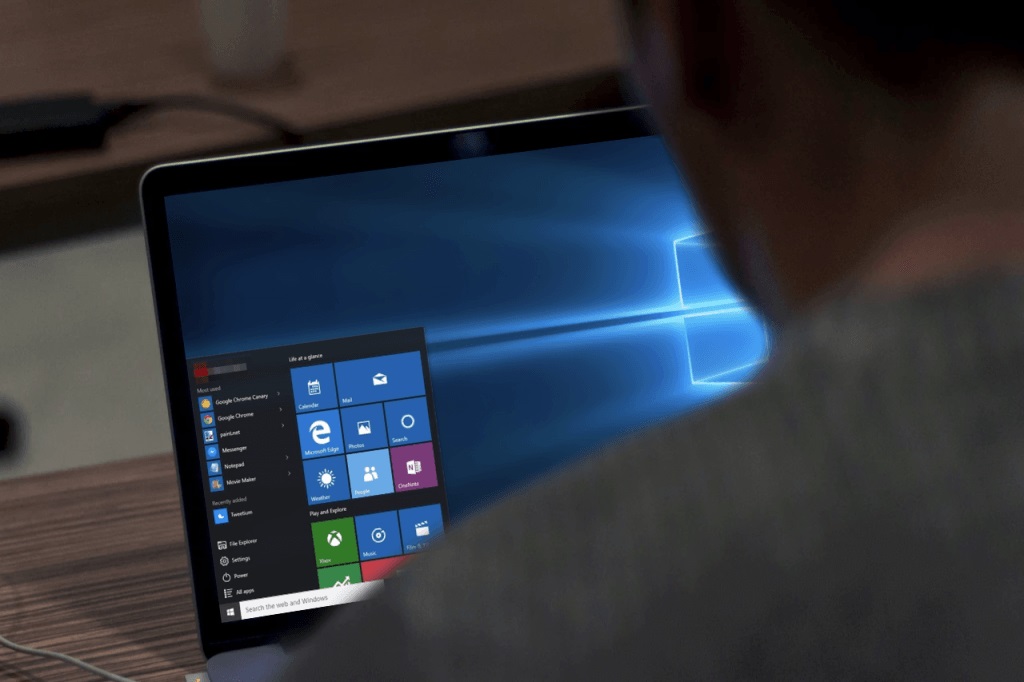
I don't know well-nigh you, but I don't even like my dominate looking over my shoulder while I'yard working. I sure equally heck don't want consummate strangers monitoring and saving information well-nigh my every motion.
Here'southward a dainty bit of info from the Microsoft "Privacy" website:
Finally, nosotros will access, transfer, disclose, and preserve personal data, including your content (such every bit the content of your emails in Outlook.com, or files in private folders on OneDrive), when we have a proficient faith conventionalities that doing so is necessary to: protect the rights or property of Microsoft, including enforcing the terms governing the employ of the services – however, if we receive information indicating that someone is using our services to traffic in stolen intellectual or concrete property of Microsoft, we will not inspect a customer's private content ourselves, but nosotros may refer the thing to law enforcement.
The Windows ten default privacy settings leave a lot to be desired when it comes to protecting y'all and your private information. Whenever I set up up a new computer or update a current setup for my family or job, I e'er carefully go through the full general privacy settings for each install, making sure to lock information technology down to make it as private as possible.
In this article, I'll have you on a bout of those settings and bear witness you which settings to modify and how to do so to best protect your personal info. This data is upwards to engagement as of the May 27, 2022 Windows x – Update Version 2004 (Build 19041.264). All information and screenshots will exist related to this build.
In some cases, y'all will have to make a decision about whether to err on the side of privacy or lean toward letting Microsoft monitor some of your actions in favor of a more convenient computing experience.
Note: Before we begin going through the settings you tin can modify to reclaim your privacy, I'd like to mention a VPN-related outcome that a recent version of Windows was stricken with. Windows 10 – Update 1903 (Build 18362.207) independent a bug that could affect the operation of VPN-added services.
It should be noted that the problems only affected certain enterprise installations of the operating system, "when the diagnostic data level setting is manually configured to the non-default setting of 0."
Afterwards updates for Windows 10 fix the issue, so make certain your enterprise machines are updated to the most recent build of Windows 10 if your machine is experiencing whatever VPN problems.
#one – Don't Use the Express Settings When Installing Windows 10
If you haven't yet installed Windows ten, or if you're planning on buying a PC with Windows x already installed, do NOT use the "Limited Settings" option when yous do your initial setup.
Instead, select "Custom Settings" and so you tin can take charge of locking downwardly your privacy from the offset.
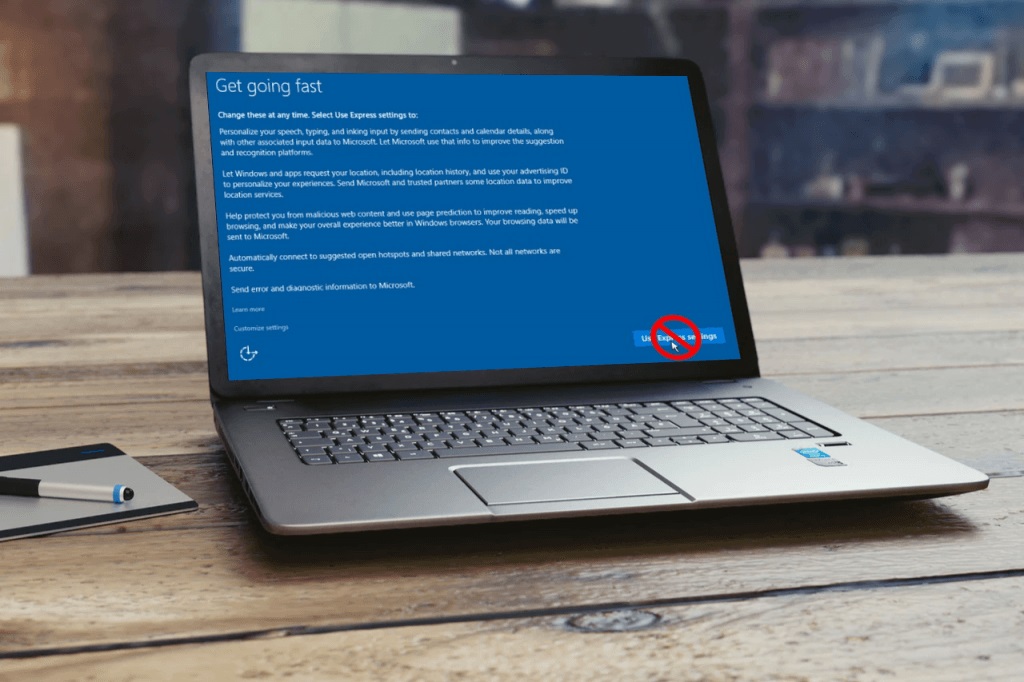
Selecting Custom Settings during setup of Windows ten will allow you lot to arrange the settings that control how your private data is accessed by Microsoft.
Quick Tip: If you're not existent hot on the thought of keeping a lot of your personal information and other data "in the cloud," consider creating a local login account instead of using a connected Microsoft account.
Go along in listen that this will prevent you from accessing any files and such that yous might have already stored in Microsoft's OneDrive cloud storage.
Equally of the Fall Creators Windows Update, Windows 10 users can at present get direct admission to the total privacy statement during installation. While I don't wait many users will actually read the entire statement, I mention information technology in order to point out that Microsoft has included "Learn More" links in the text.
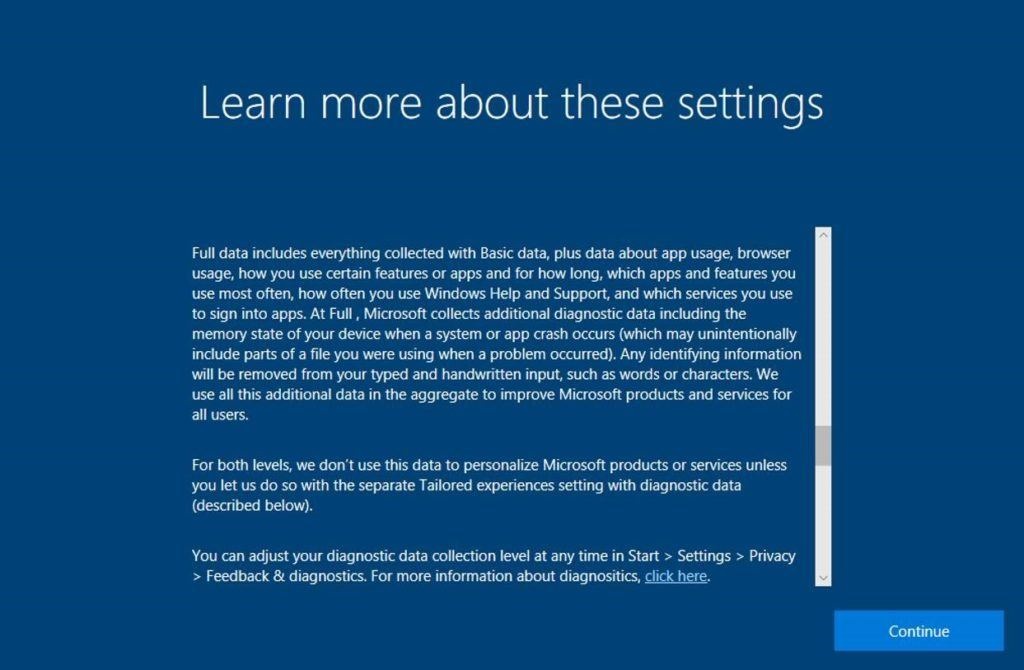
The "Learn More than" links permit users to spring to relevant parts of the statement that might interest them. The sections include such information as to how Windows x handles speech recognitions, location services, diagnostics and more than.
#2 – Restrain Cortana
Cortana is Microsoft's entry into the virtual-banana sweepstakes.
Much like Apple's Siri and Google'south imaginatively-named Google Assistant, Cortana is a voice-activated intelligent personal assistant. It recognizes natural voice commands and can respond questions by accessing Microsoft'due south Bing search engine.
In improver to performing searches, Cortana can also store and admission personal information such as reminders, contacts, calendar dates and more than.
A major drawback of the Cortana banana is that it indexes and stores your information, both on the local computer and in the cloud. (This allows Cortana to synchronize information across all of your Microsoft devices.)
Equally of the release of the Windows ten 1903 Update, Microsoft dissever Windows Search and Cortana in the taskbar.
Y'all'll now find Cortana every bit a divide icon next to the desktop search bar, as seen beneath. Clicking the search box in the taskbar now offers search functionality, while clicking the Cortana icon will actuate a vocalism-first digital assistant feel.

Privacy advocates accept long been concerned about the way Cortana gathers and stores personal user information. This has led Microsoft to allow users to somewhat command what Cortana accesses and stores.
Nonetheless, what Microsoft giveth, Microsoft also taketh away.
As of the latest version of Windows x (the Creators Update is the latest as of this writing), the company has taken away the ability to toggle Cortana on and off.
Luckily, there is still a fashion to turn Cortana off, but information technology requires editing the registry and rebooting your computer.
For those non comfortable with dallying around in the Windows Registry, there are still ways to become Cortana to back off a chip from accessing everything you say or do on your PC.
one. Controlling What Cortana Can Do
It'due south like shooting fish in a barrel to limit how much admission Cortana has to your personal data and make it perform more like the Windows search box of former.
You lot can forbid it from collecting information virtually your voice communication and handwriting patterns, besides as your text entry history. In addition, yous tin stop the banana from sharing your usage history beyond all of your Windows devices.
The Cortana settings are bachelor in the Cortana app, as seen below. To admission the Cortana settings, offset the Cortana app by clicking the Cortana icon in the task bar, so clicking the menu button in the upper left-hand corner of the Cortana window (it looks like this: "…").

In the Settings screen, you'll see a "Privacy" menu option in the "Business relationship" section. Click that.

The next screen you'll see is the Privacy settings. Hither you can view what Cortana knows about you, control Cortana'due south access to your Calendar and Electronic mail, articulate all Cortana data and clear your Cortana Chat History.

Talking to Cortana
Besides in the Settings section of Cortana is the "Talking to Cortana" option, equally seen below.

When y'all click this menu choice, yous'll see the screen below, where y'all tin command whether or non Cortana is continually listening for its summoning phrase, "Cortana." If you turn it on, y'all tin fix Cortana to answer when anyone says "Cortana."

If this is toggled to "Off," information technology won't monitor your speech, possibly lowering the chance of your vocalization being monitored. As a nice side benefit, your Windows laptop will terminal a fleck longer when information technology'due south running on battery ability.
If this one is toggled to "on," you can printing the Windows logo primal + C to tell Cortana to heed to your commands. If you decide to permit Cortana hang effectually, this might be the way to become. It won't listen for anything until you printing the shortcut primal combo.
Permissions & History
In the Permissions & History department of the Cortana settings, y'all can review the activity from all of your Cortana devices, alter what the personal assistant knows virtually you in the cloud, manage the information Cortana has admission to and manage what she can access from other services.
- Cloud Content Search
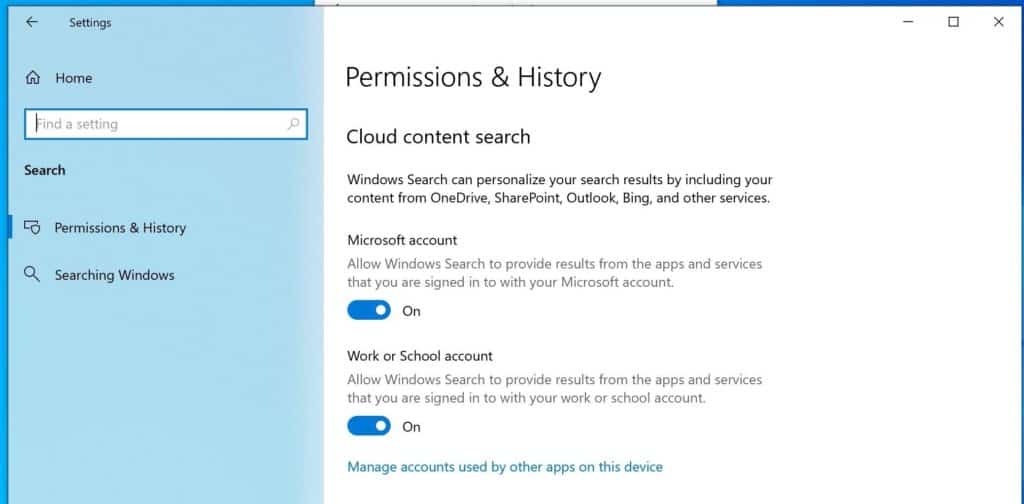
When this is turned on, Cortana will include your content saved in the cloud, such equally on your OneDrive storage, when providing search results. If you lot want to accept access to all of your files, no matter where you saved them, you'll want to take this set to "On." If you lot're more concerned with security, toggle information technology to "Off."
(Note: As of the Windows ten 1903 Update, you'll discover this toggle in the "Search" section of the Settings app. In earlier versions of Windows 10, you'll still find it in Cortana's settings.)
- History
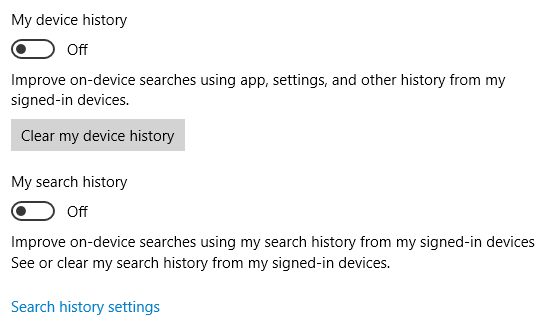
By default, Cortana saves the searches you perform in apps, settings and other histories from any devices that you sign in on with your Microsoft account. You can disable the device history in this area and clear the history on your device. You can disable "My search history" by toggling it to "Off."
(Notation: As of the Windows 10 1903 Update, you'll detect this toggle in the "Search" section of the Settings app. In earlier versions of Windows 10, you lot'll even so find it in Cortana's settings.)
2. Turn Off Cortana Personalization
To disable Cortana'south personalization, to end data collection and to clear all of the data Cortana has associated with a particular device, practice the post-obit:

Click your mouse pointer on the Cortana search icon, found in the toolbar of your Windows 10 desktop. Once the Cortana display appears, click the bill of fare icon and then the "Sign out" icon, equally shown in a higher place.
When the Account window appears, click the "Sign out" link for your Microsoft account.

When you sign out of Cortana on your reckoner, the data nerveless past Cortana associated with that PC is automatically cleared. Information collected by Cortana on other devices remains intact until you sign out of Cortana on those devices.
3. Hide Cortana
If you'd like to keep Cortana completely out of your way, brusk of digging into the Windows registry, practice the post-obit:
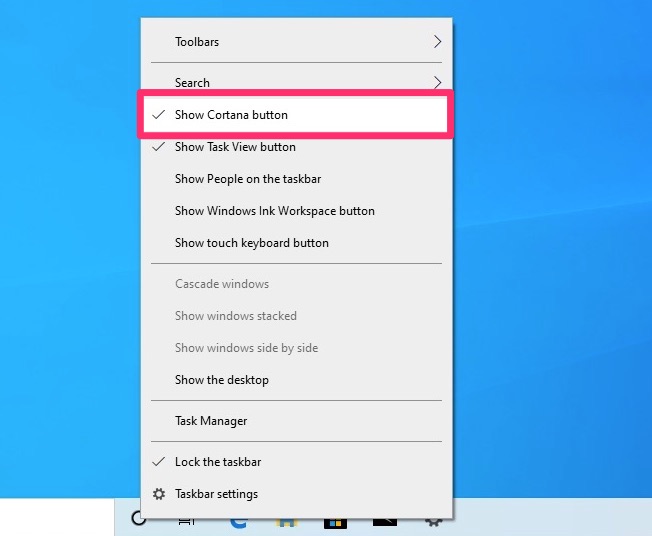
- Right-click anywhere on the taskbar.
- Click the "Testify Cortana push button" pick to toggle showing the Cortana button in the taskbar.
four. Cortana Speakers
With the release of the Windows 10 Fall Creators Update, the operating system now supports dedicated Cortana speakers, which tin can be gear up from your PC and used effectually the house.
The speakers operate much similar Amazon'southward lineup of Echo Alexa-powered speakers and Google'due south Home speakers. The commencement available speaker to brand use of Cortana is the Harman Kardon Invoke.

The Cortana speakers, in addition to being able to play music from streaming services or from your PC or mobile device, will be "always on," listening for questions and commands from users. The privacy risks of these new speakers are comparable to those presented past the Alexa and Google Home speakers, and should be considered before purchasing and using the speakers.

#iii – Turn Off Ad Tracking
If yous decided to go with "Express Settings" when y'all installed Windows x, y'all can be sure the operating organisation is tracking your every move and mining your personal data for everything information technology is worth.
This includes supplying information to its ad partners, who and so use that info to testify ads targeted at yous, online and inside Windows itself.
When ad tracking is enabled, Windows generates a unique advertising ID for each user, which is intended for use by app developers and advertising network to "provide more relevant advertising in apps." Apps can admission the ID and utilise it in much the same fashion websites access and apply a unique identifier included in a cookie.
I should note that such tracking is nothing new, every bit Google and other search providers accept been doing the same thing with cookies and information they collect from your web searches. (Which is why those foot mucus ointment ads are following you around wherever you proceed the internet. You actually should consult with your medico nearly that.)
To turn off advert tracking, practice the following:
- Click or tap the Windows First button in the lower left-hand corner of your Windows desktop.
- Click or tap the "Settings" icon. (It's that little gear just in a higher place the "power" button icon.)
- Click or tap the "Privacy" icon in the Settings menu.
- In the Privacy carte du jour, click or tap the "General" menu option if information technology isn't already selected.
- Turn off "Let apps utilize my advertising ID for experiences across apps," equally shown below.
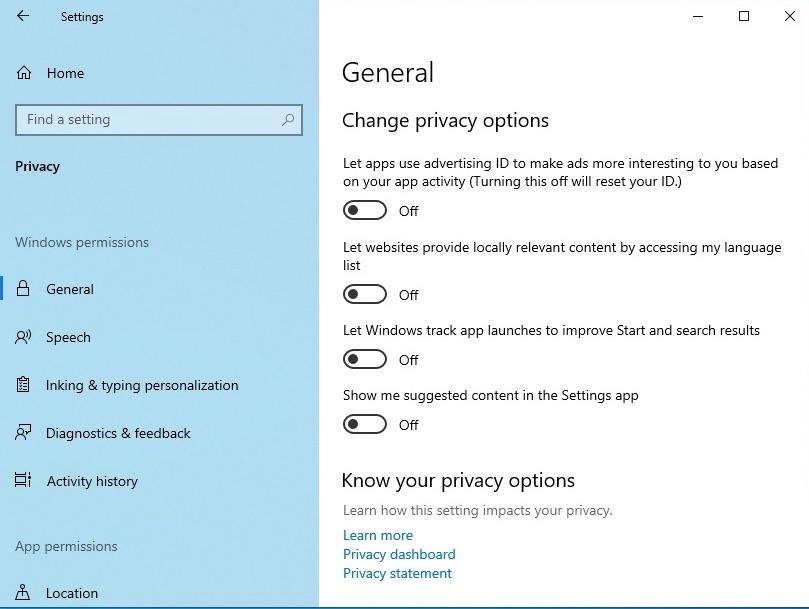
If you're interested in protecting your privacy while using Windows 10, this is a corking identify to kickoff. I would toggle all four settings shown in the screenshot above to the "Off" position.
These 4 options are:
- "Let apps use advertizement ID to make ads more than interesting to you based on your app action." (If you plough this off, information technology resets your ID – which is a skillful thing.)
A note from Microsoft near this pick: Turning the advertising ID off will non reduce the number of ads you meet, just it may mean that ads are less interesting and relevant to y'all. Turning it back on will reset the ad ID.
- "Let websites provide locally-relevant content past accessing my language list."
- "Let Windows rail app launches to amend Start and search results."
- "Show me suggested content in the Settings app."
#iv – Disable Location Tracking
When Location Tracking is turned on, Windows and its apps are allowed to detect the current location of your figurer or device. This tin be used to pinpoint your exact location.
This is especially handy for mobile devices, such as Windows tablets or Surface devices, due to location-based apps such as eating place finders and navigation apps.
While it is a handy feature, it's also a privacy-leaking feature that should likely be turned off if you truly desire to protect your identity on the web.
Shutting off this characteristic on your laptop is likely to have less impact than turning it off on a mobile device, due to the latter'southward mobile nature and heavier use of location services.
I generally go along Location Tracking turned off on my desktop and even laptop devices. I utilize an iPhone for my daily calling and texting needs, and I leave location tracking turned on for my handset (but only for things like "Discover My iPhone" and "Find My Friends.")
Past leaving both turned on for my iPhone, my wife knows where I am at all times in case of an emergency. And I, of course, know their whereabouts for the same reasons.
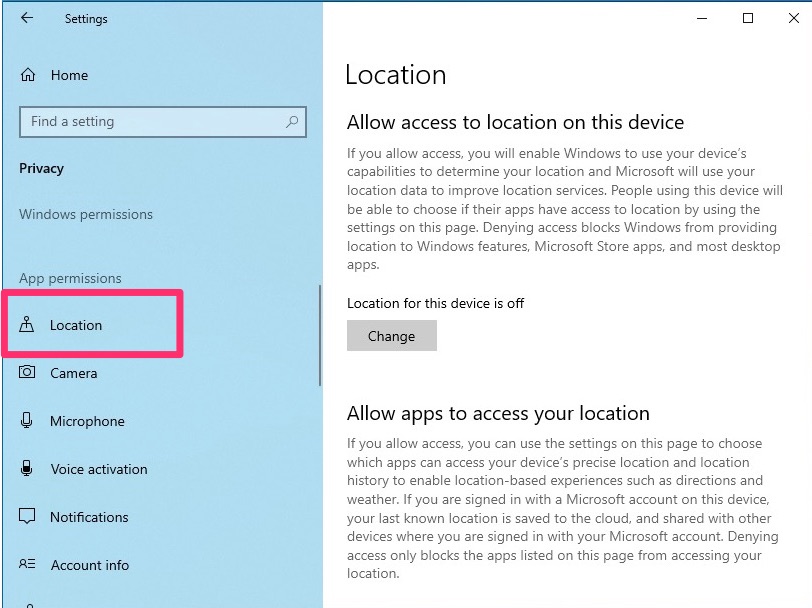
Location for a device can be either gear up for a device or simply a detail user.
To plow off Location Services for a device, go to the "Privacy" department of the Settings app and click "Location." Once there, toggle the "Location for this device" switch to "Off" to disable Location Services for all users of the device.
If the "Location for this device" switch is left to the "On" position, it will be left up to y'all whether or not Location Services are enabled for your login on the device, as shown beneath.
When the Location Service is turned on, as seen above, any app that is making use of the device'due south location will display a unique icon, which looks like a dot with a circle around it.
Default Location
If location is turned off completely, skip to the next relevant section.
If desired, y'all can too set a default location for those times when Windows can't detect a more precise location. If y'all are leaving location settings enabled, and you're on a desktop figurer, this could exist helpful.
Location History
If Location is on, Windows will store your location history "for a limited fourth dimension" on the device, and any apps that use the Windows location information can access the history.
If y'all're sensitive nigh sharing where yous've gone in the past, press the "Clear" button as seen below to erase the location history stored on the device.
Annotation: Pressing the "Clear" button gets rid of the location history stored locally, just not in the cloud.
To articulate the location info that may have been stored in the cloud, yous'll need to click or tap the "Manage my location info that'southward stored in the deject" link, as seen below. Windows will open up a browser window where you lot tin can then erase your cloud location info.
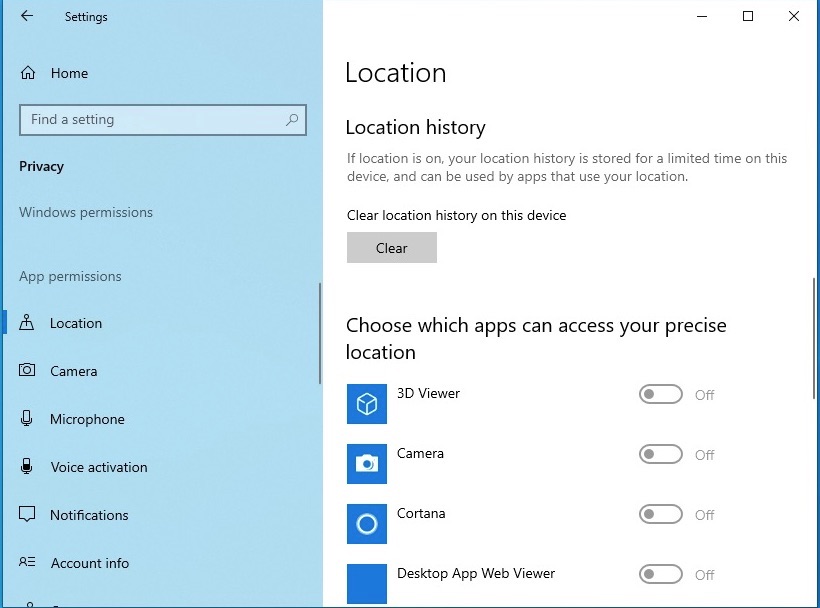
Users tin can also specify which apps can access and brand use of your location information. Any installed app that can take advantage of that data will exist displayed in a listing. Users can then toggle the app'due south location access off or on, as they desire.
Geofencing
Geofencing uses GPS information, or local radio frequency information such as Wi-Fi networks or Bluetooth beacons, to create a virtual boundary around a location.
This enables devices and apps to offer y'all information, such as a special at a nearby restaurant, or a reminder to pick upward your dry cleaning when yous're near the cleaners.
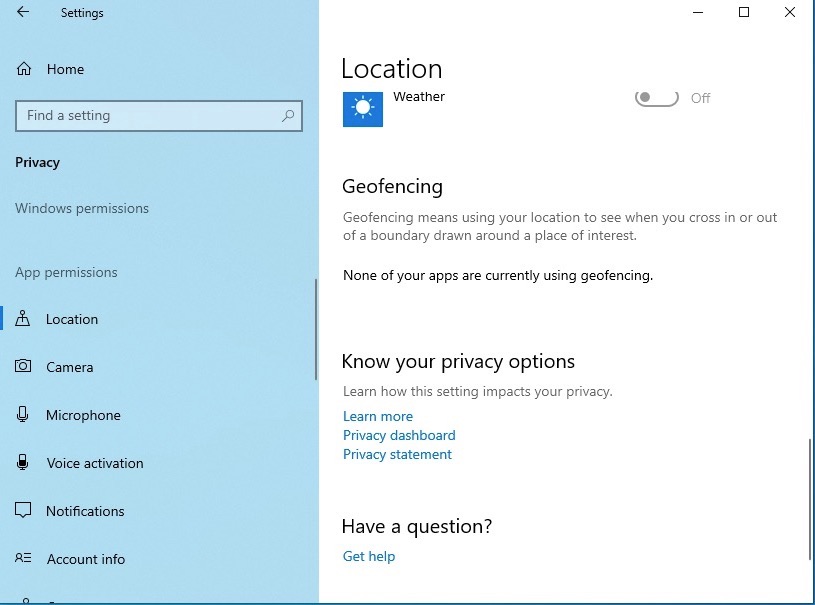
While geofencing can exist a valuable tool in mean solar day-to-24-hour interval activities, it as well uses your device's location, which means it knows where you are and where you've been.
An app can use geofencing if Location Services are turned on for that app. And then, suit permissions appropriately.
#5 – Command Camera Access
Have you ever felt like someone was watching yous? (And you had no privacy? Woh-oh-oh.)
My mother-in-police force actually puts tape over the born camera on both her laptop and her tablet. (I guess I shouldn't mock her – the word is that Marking Zuckerberg, the founder of Facebook, also puts tape over his webcams.)
Camera access in Windows 10 tin exist easily controlled. Using the "Photographic camera" carte du jour in the "Privacy" section of the Settings app, you lot can completely turn off access to your computer or tablet's built-in or continued camera. You tin also set camera access on an app-by-app ground.
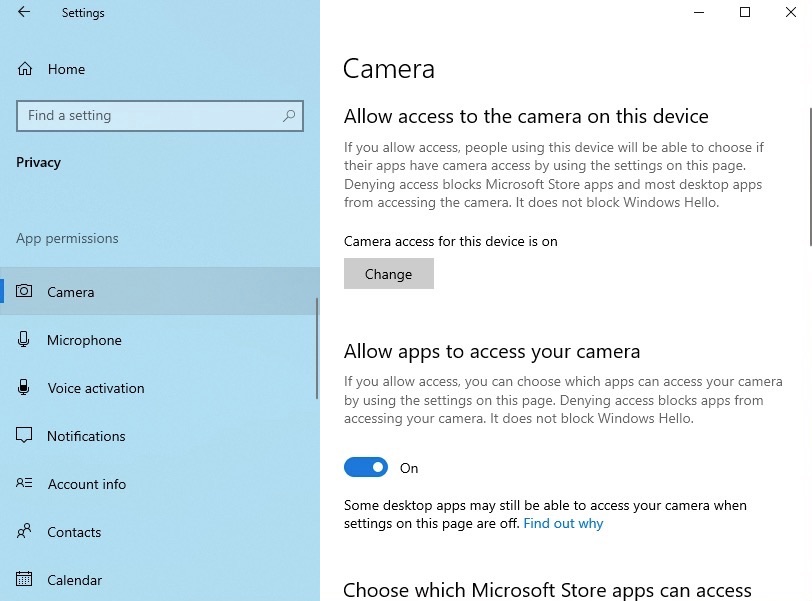
General access by the system is controlled by the now-familiar toggle switch located simply nether the "Let apps use my camera hardware" label, every bit seen to a higher place.
For those of yous who may have only skimmed the article, toggling a switch similar this to "On" allows Windows apps access to that particular feature. Toggling information technology to "Off" disallows any access.
While camera access is a genuine privacy concern, I usually leave mine on for my account and plough it off under my kids' accounts. While I prefer to set camera access on an app-past-app ground for my account, I feel safer with apps under my children's accounts not having admission to it.
If the toggle switch is ready to "On," you tin control each individual app's access to the photographic camera by using each app'southward associated toggle switch.
When turning camera access off for an app, it should be noted that this only prevents the app from directly accessing the camera hardware. It can still request to open the born Windows Camera app, which can only capture images or video when you explicitly permit it to practise so.
Heck, maybe Zuckerberg has information technology right – just put a sticker or a slice of tape over the camera. If Edward Snowden is correct, the NSA has at least a couple of ways to spy on you via your computer's camera. That same Wired study provides some links to a adept number of stylish means to embrace the photographic camera. Yes, Hello Kitty stickers as well.
#6 – Control Microphone Access
While assuasive Windows access to your estimator'southward microphone – whether it exist built-in, or the continued type – might not seem as much of a privacy hazard as allowing access to the device's camera, information technology can still be a touchy subject area.
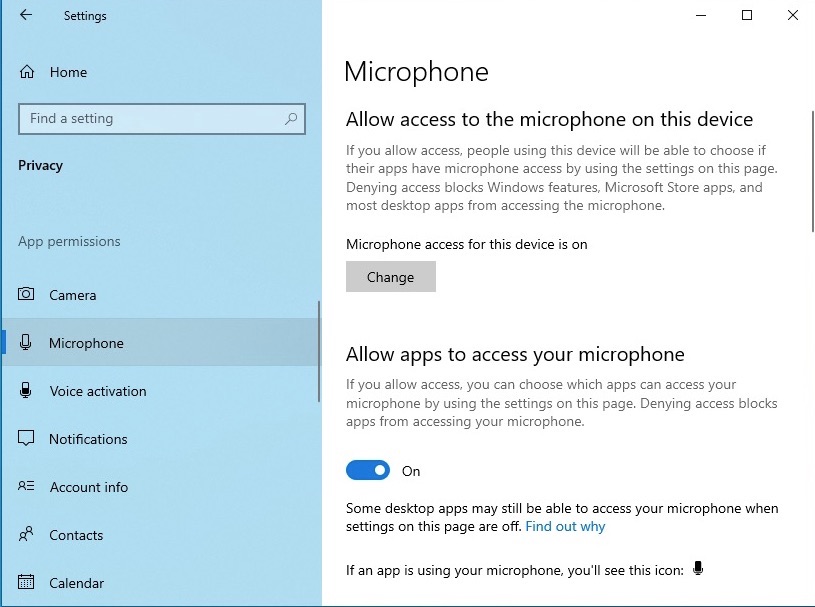
Just every bit with my Camera settings, I leave the "Permit apps use my microphone" toggle switch to "On" and then make up one's mind which individual apps to let to have access to the mic. Information technology but makes sense to permit Skype access to the mic, while Photos and the Windows Shop don't really need information technology to function properly.
For this setting, I would say permit or block on an app-level basis. It volition go clear to you after a while which apps actually require access to your device's microphone.
Mark Zuckerberg also puts a piece of tape over his laptop'south congenital-in microphone – so perchance you should get that scroll of black record out of the drawer, also.
#7 – Speech, Inking, & Typing
These sections of the Privacy dashboard settings command how yous tin can utilize your voice to talk to Cortana, or certain applications you download from the Windows Store. It too uses your voice input to better Microsoft's cloud-based spoken language services. (So, yep. Information technology sends your vox samples to the cloud.)
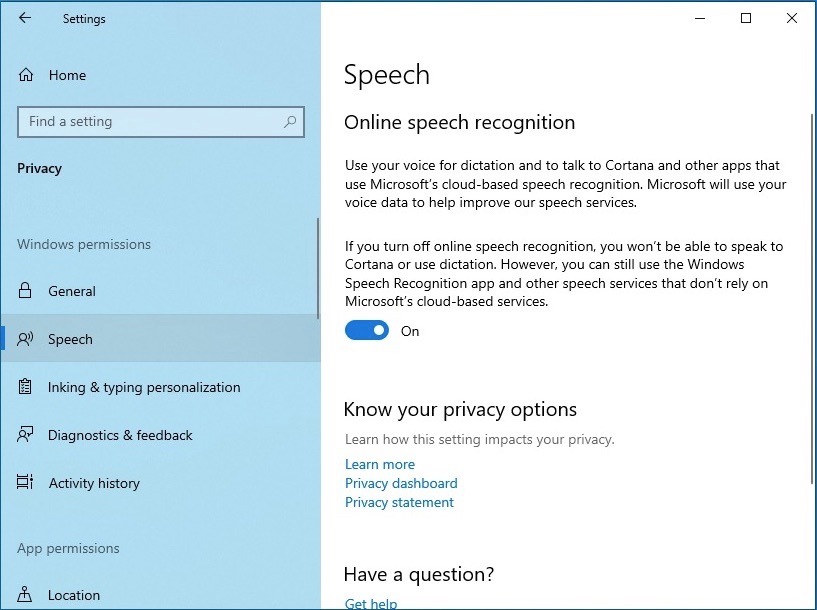
It as well controls if Windows uses your typing history (and handwriting patterns on Surface devices and other tablets) to create a local user dictionary, which is supposed to make amend text-entry suggestions for you.
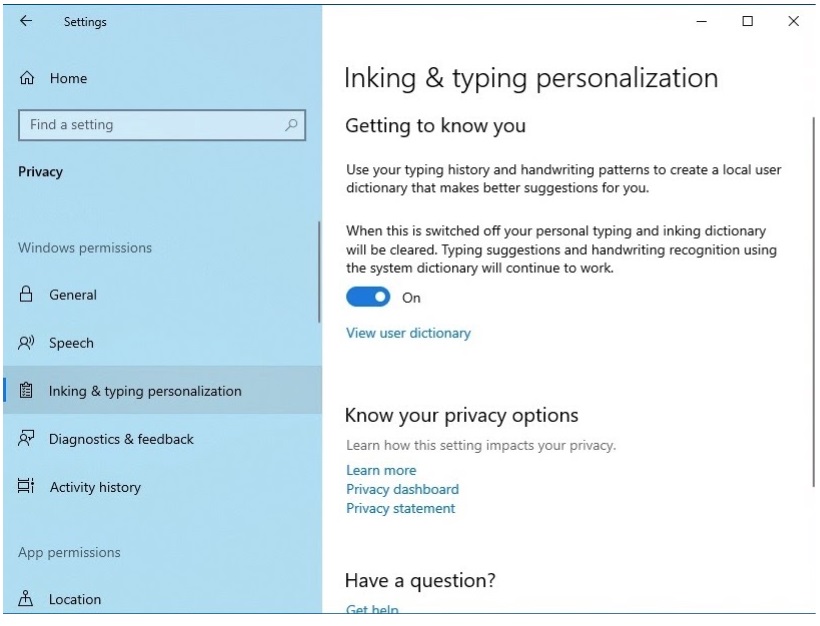
When this is toggled off, you can no longer speak to Cortana, and your typing and inking user dictionary will be cleared of data. Some speech services, those that do not rely on the cloud, will still work. Typing suggestions and handwriting recognition using the local system's dictionary volition also still work.
Toggling this setting to the "Off" position will assistance yous in your effort to improve your privacy, but it will too pb to the loss of some features yous accept become used to.
Every bit seems to exist the manner of the online world these days, you'll need to walk the tightrope between convenience and privacy.
A Quick Note About App Access
Before we examine the settings that control what kind of access Windows apps take to your personal data – such as Contacts, Calendar, Business relationship Info and more – allow's take a wait at a statement from Microsoft about such controls.
Exceptions to the privacy settings
Desktop apps won't appear in your Choose apps that tin utilize/admission/control/read my [Capability] lists and are not affected past the Allow apps apply/access/read my [Capability] setting. To allow or block desktop apps, utilize the settings in those applications.
How can you tell if an app is a desktop app? Desktop apps are ordinarily downloaded from the Cyberspace or installed with some type of media (such equally a CD, DVD, or USB storage device). They're launched using an .EXE or .DLL file, and they typically run on your device unlike web-based apps (which run in the cloud). You tin also find desktop apps in the Windows Store.
Basically, what this means is that whatsoever app you install yourself, be it downloaded from the internet or installed from a CD – or yep, even a floppy – is not appreciative to respect your Windows data access settings. As always, be damned careful well-nigh installing apps from unknown sources.
With the release of Windows 10 Fall Creators Update, users accept greater control over which apps can access their information, camera, microphones and other privacy-sensitive objects.
Previously, users were only prompted to grant an app access if the app required admission to a user'southward location data; all other permissions were granted automatically. Apps installed via the Windows Store will now require explicit permission to an app before it tin have access.
The new rules only utilize to apps installed from the Windows Store after the installation of the Fall Creators update. Still, users can manage permissions for existing apps by going to "Start" -> "Settings" -> "Privacy" and selecting an individual app before then turning app permissions on or off.
#8 – Command App Access to Your Account Info
This setting controls whether or non to allow apps to admission your user information. Such information includes your name, photo and "other account info." (Thank you for the details, Microsoft!)
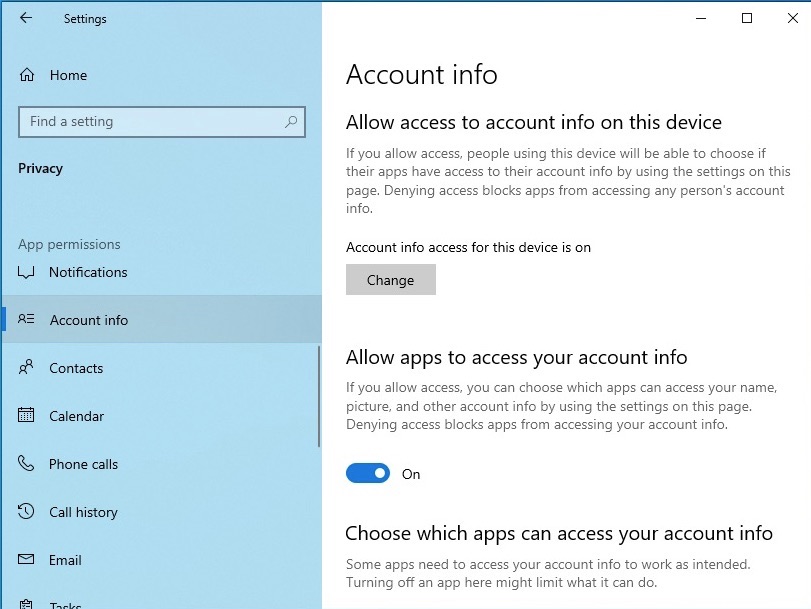
Toggling this setting to "Off" blocks access by whatever apps. Toggling information technology to "On" allows decision-making access to such information on an app-past-app basis. Microsoft claims turning off Account Info access for an app may not let it to work as intended.
When the option is set up to "On," you'll come across a listing of apps that might need Account Info admission. You tin can turn that access on or off on an individual footing. I suggest contacting the developer of whatsoever app you might take questions about and query them equally to what blazon of Account Info the app uses.
#9 – Control App Access to Your Contacts
Judge what the Contacts toggle switch does?
No, it doesn't accept anything to do with that sticky paper your Mom used to line her kitchen shelves with. This switch decides whether Windows apps volition have access to your Accost Volume.
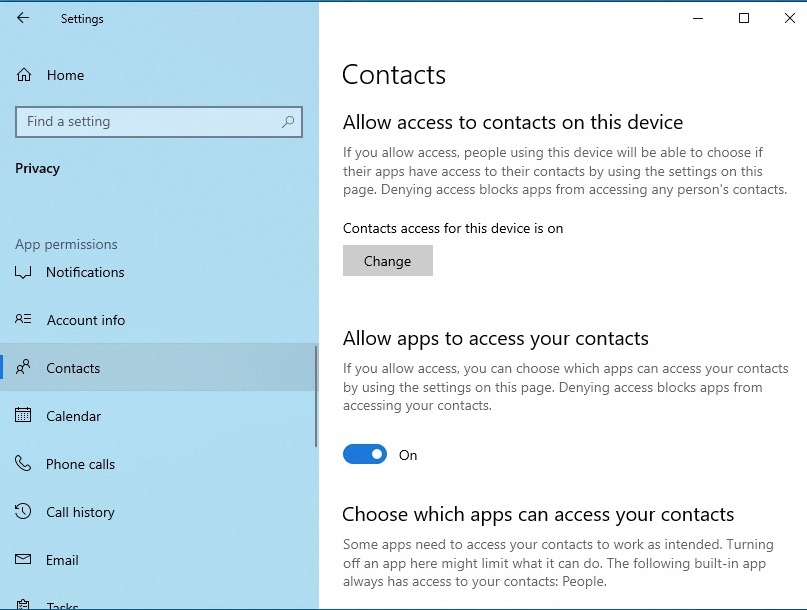
If you toggle this i to "Off," it blocks all apps from accessing your Contacts. Toggling it to "On" allows you to designate which apps get the golden ticket to access your Uncle Al's phone number. (It'due south a landline. Uncle Al rolls old-schoolhouse.)
Equally with the Account Info toggle, if you lot plough this off completely, or on an app-past-app basis, it may cause some apps not to operate as intended. This is another field of study you should contact the developer on for any app you might have questions about.
#10 – Command App Admission to Your Calendars
This should be getting somewhat familiar by now. This switch controls app access to your Calendars. When it's toggled to "Off," it turns off all app admission to your Calendar info.
When information technology's turned on, and so yous become to determine which lucky Windows app gets to look through your upcoming dates. (And I use the term "dates" loosely. "Dinner with Uncle Al" is not a engagement.)
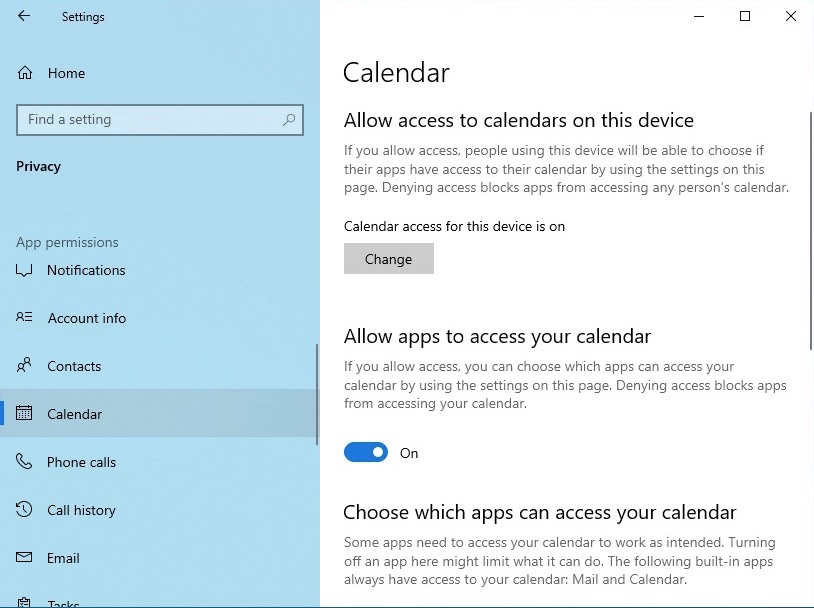
What you lot do in these settings depends on how you use your figurer and the various apps that might need admission to your Agenda information.
I myself did some experimenting with the settings until I institute a level that offered a mixture of privacy and convenience that I could exist comfy with.
#11 – Control App Admission to Your Call History
Windows Privacy settings too control an app'due south admission to your call history. If you turn this off, it disallows all apps from accessing any of your call history data. Turn this on, and you tin can fix access to said info on an app-by-app basis.
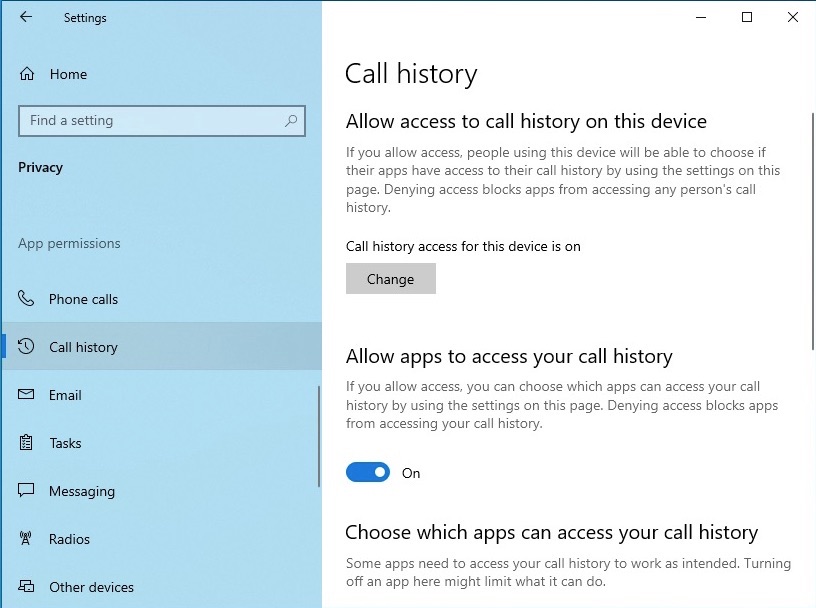
Personally, I go along this turned off. I don't brand any calls via my Windows estimator, or a Windows Phone, as I use an iPhone to make calls. However, your mileage may vary, and you lot may discover you need to command this on a granular level.
#12 – Control App Access to Your Email
I don't know nearly you, merely access to my electronic mail, both personal and business organization-related, is a touchy subject for me. I barely trust any e-mail provider not to monitor my inbox, let alone other apps.
My email is my lifeline to the exterior world. Virtually all of my communications with business associates, as well as friends and family unit, usually pass through my inbox. I am very protective of the years of information that bit of storage holds. (I'm reasonably sure I even so accept the first email I ever received in my get-go Gmail account years ago.)
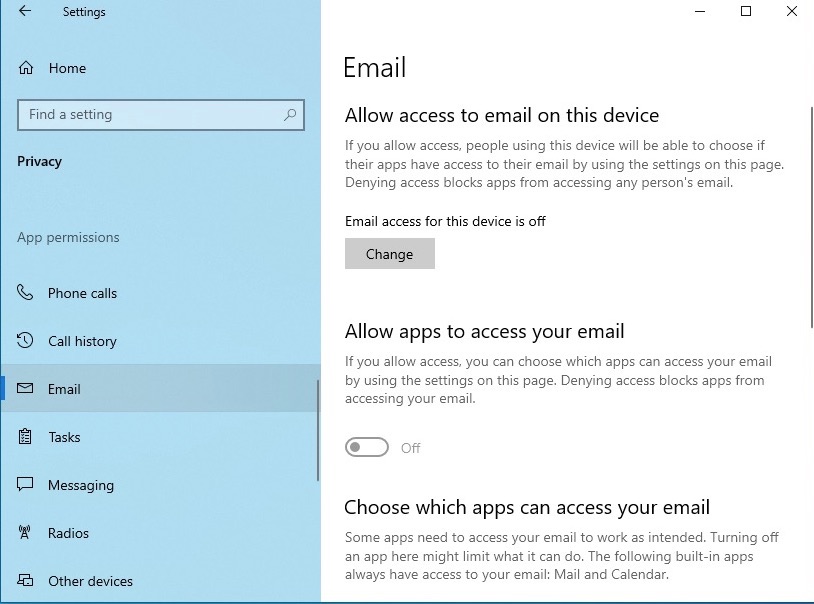
I turn this one completely off – simply if you have a specialized app that actually needs access to your email, then you lot might want to do things on an app-by-app basis.
#13 – Command App Access to Your Tasks
Tasks can be some other sensitive subject with me. My daily tasks list is the bible I build my mean solar day-to-twenty-four hour period piece of work life on, and I'm touchy about anyone gaining access to this data. (Heck, if I didn't have to, I wouldn't even share the info with my boss, merely…)
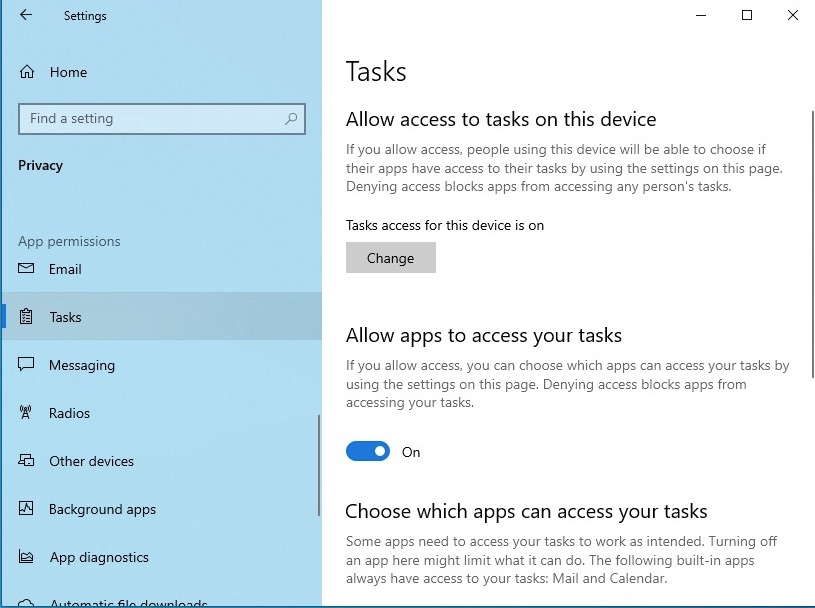
As we've seen with similar groups of settings, turning this switch to "Off" shuts every app out of your tasks information. Leave it on, and it's your responsibility to look through the app list and decide which apps really need access to the listing.
It should exist noted that the built-in Post and Calendar apps volition always have access to your tasks, no matter what settings you make up one's mind on, which makes sense.
#14 – Control App Access to Your Text Messages
I don't exercise much messaging via Windows. Most of my messaging is performed through my Mac and iOS devices. Still, I do use Skype on my Windows PC, so this setting matters a bit in my example.
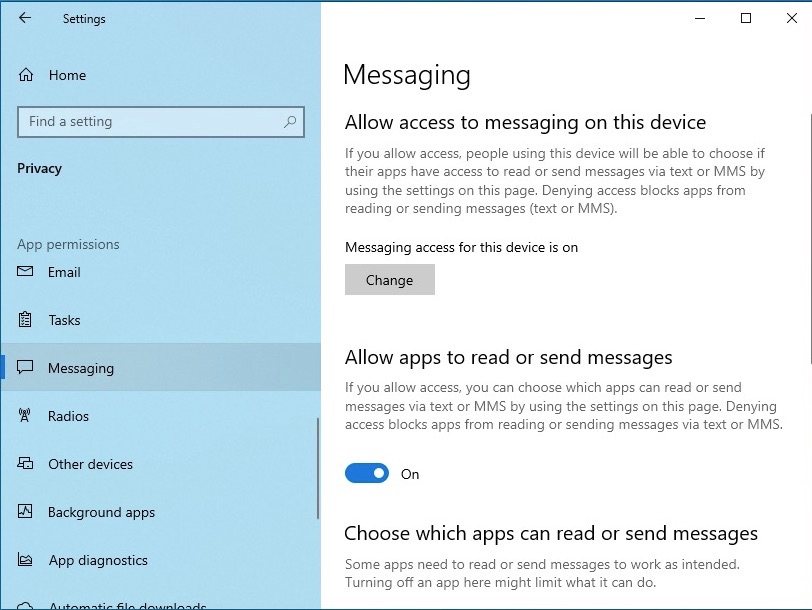
On this screen, you can either go all the style, turning off messaging admission for all apps, or exit general access turned on, and decide on an app level as to which apps really need access to your text messages.
#15 – Command App Access to Your Computer'south "Radios"
When I say control access to your computer'south radios, I don't mean the one it uses to listen to Cubs games during baseball game season. The radios nosotros're looking at are the Bluetooth and Wi-Fi transmitters your Windows computer uses to connect to local networks, accessories and other devices, such as beacons.
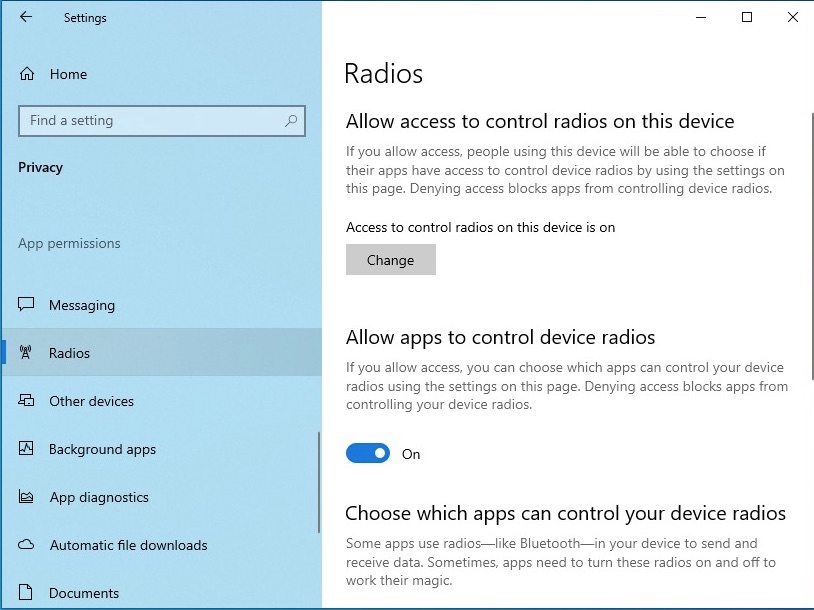
Allowing access to your computer's radio capabilities has some fairly significant privacy implications. Past enabling admission, y'all could leave yourself open up to tracking via your Wi-Fi and Bluetooth signals.
Admission to radios are also used to share information, similar files, messages and other centrally located info, so turning off app access may be ill-advised. All the same, unless you lot're enlightened of a particular app yous use that requires this access, I'd exist inclined to advise you to turn information technology off.
#16 – Control App Access to Your Computer's "Other Devices"
This part of the Privacy dashboard allows you to choice and choose how apps share and sync data with those devices that do not already specifically pair with your figurer. Equally usual, yous tin can turn it off completely, or leave it on and pick and choose which apps are allowed to share info with those "other devices."
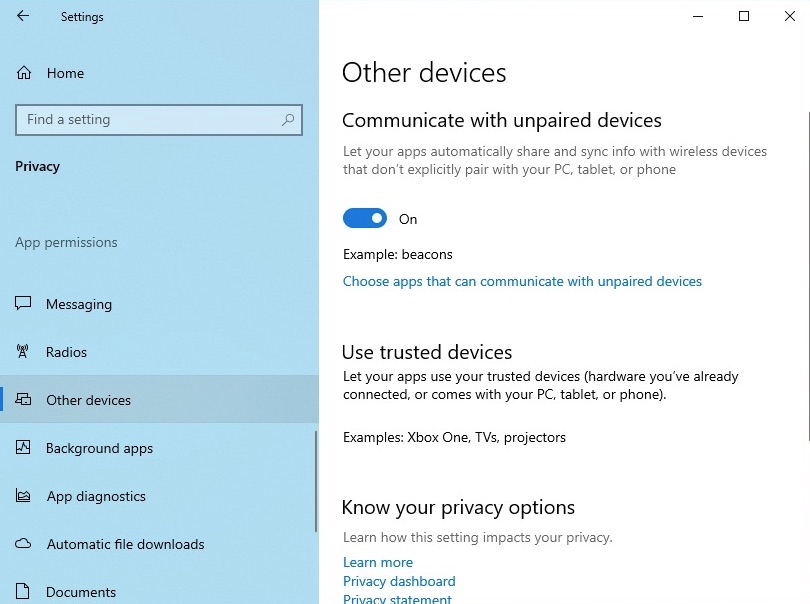
Y'all'll desire to be careful which apps you allow to sync with other trusted devices; this could represent a fleck of a security pigsty if the apps are playing fast and loose with your personal data.
If yous're in doubt, contact the developer of the app. Whatsoever reputable developer should exist more than than happy to explicate what the app might share.
#17 – Control Diagnostics & Feedback
This is where you lot control how much diagnostics and usage data Windows will phone home to Microsoft.
The Redmond business firm doesn't allow users to plow it completely off, so the all-time y'all tin can do here is click the "Basic" radio push to transport the minimal amount of information possible back to the mothership.

Toggle off the switch right below the "Let Microsoft provide more than tailored experiences…" paragraph. At that place's no reason to be sending that info.
The final option in this department is how often to allow Windows to ask you lot for feedback. While some people are generous with their fourth dimension, others only don't want to be bothered.
You tin can gear up this for "Never" (my favorite) or permit it to ask y'all for feedback anywhere from once a week to "Automatically." If you're a sharing kind of person, become ahead and permit them ask for feedback to their eye'due south content. As for me, I prefer to go along information technology to myself.
#18 – Control Background Apps
This department allows you to decide what apps, if any, will exist allowed to run in the groundwork, quietly sending and receiving data, offering notifications and updating themselves, even when they're non existence actively used.
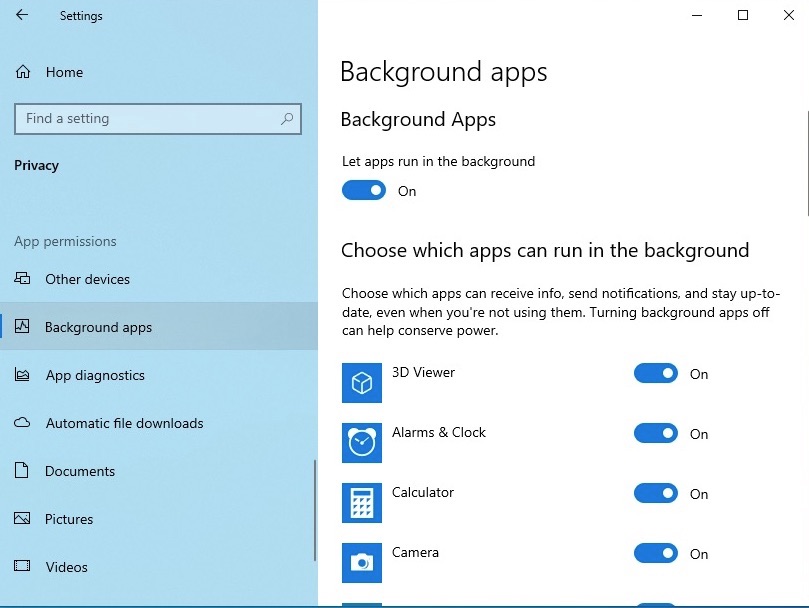
You can turn off background apps completely or select 1-by-one which apps volition be allowed to sit in the background, sending info and eating upwards precious processor cycles and battery life when y'all're out and about.
I don't know how you feel near things, merely I don't recall Processed Crush needs to be running in the background. Pick and cull wisely, my friends.
#19 – Command App Diagnostics
In this final department of the Privacy dashboard, the user is required to decide whether or non to permit apps to access diagnostic data about other apps. Microsoft says some apps use diagnostic data from other apps to run as intended.
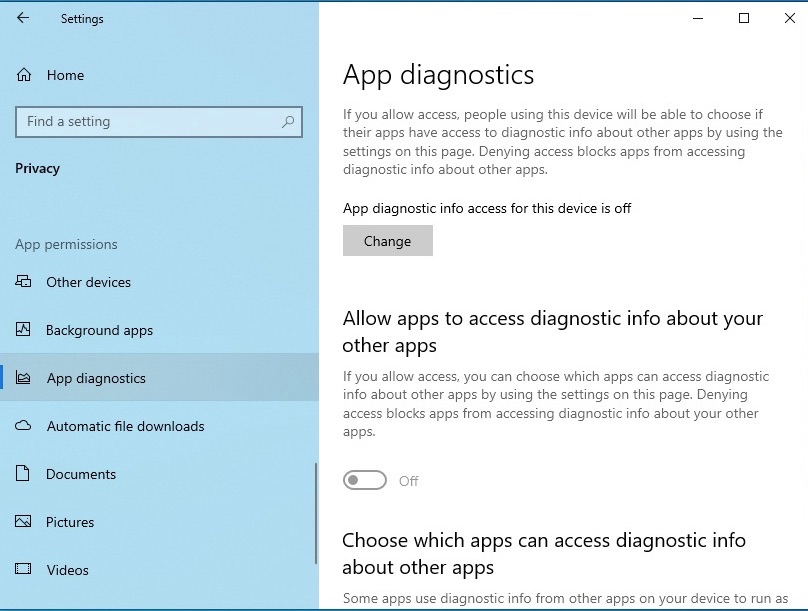
Information that could be accessed includes the user business relationship that launched an app, as well as the app's memory, CPU, disk and network usage (we are already "sharing" too much info…).
While I know sharing is caring, I say turn this one off. If you find an app that previously had access to this information isn't operating equally it should, then turn information technology back on for that single app. Otherwise, avoid this one like the plague. (I particularly don't like the whole "who launched the app" scrap of info it collects.)
#20 – Automatic File Downloads
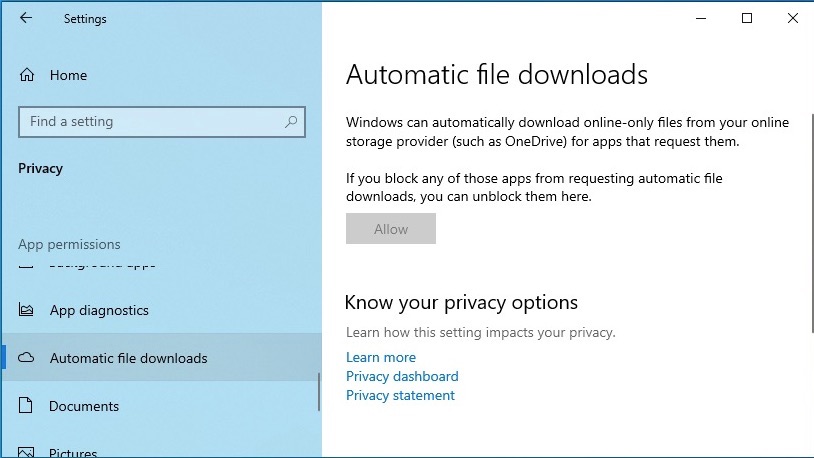
"Automatic File Downloads" is a new addition to the general Privacy settings in the Windows 10 Fall Creators Update.
This section allows you to unblock apps from automatically downloading online-just files from OneDrive and other online deject storage services. If y'all employ online storage to keep your hard drive from filling up, you'll probable want to allow apps to accept admission to cloud-just files on a case-past-case basis.
#21 – Manage Privacy Settings in the Edge Browser
Microsoft Border is the default browser in Windows 10. It replaces the venerable but long-overdue-for-retirement Internet Explorer as Microsoft's browser of pick.
Microsoft says Edge is clean, lightweight and fast. But nowhere do they mention that it is more secure.
In this section, nosotros'll have a expect at the Border browser and which settings require a closer look in order to protect your privacy. I'll guide you lot through the settings and talk over what they command, and how they should be adjusted to offer consummate privacy.
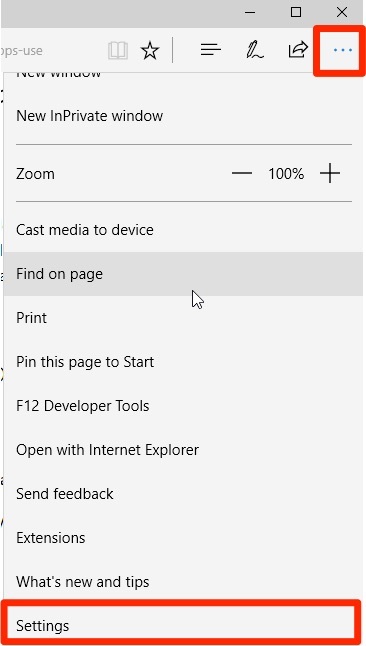
To access Edge's privacy department, run the browser and then click the three dots ("…") found in the upper correct-paw corner of the browser. In the menu that opens, curlicue down until yous find the "Settings" option. Click that.
The settings I'll be showing you reside in the Settings and the Advanced Settings areas of the Edge menu
i. Clear Browsing Data
While yous're in the Settings bill of fare, scroll downwardly until yous see "Clear browsing information." Click the "Choose what to clear" button.

In the "Choose what to clear" menu, you'll see advanced options for what yous can delete from the Edge browsing data. Default things to clear include: browsing history, cookies and save website data, buried data and files, tabs that take been prepare aside or recently closed, download history, grade information, passwords, media licenses and website permissions. Too available are location data permissions, too as webcam and microphone permissions.

Select the browsing data you lot'd like to articulate and so click the "Articulate" push button.
Yous tin can also toggle the "E'er articulate this when I close the browser" switch to "On," and and so Microsoft Edge will automatically clear the selected information each fourth dimension the browser is airtight. This is a corking thought for the privacy-inclined – yet forgetful – users amid united states.
What yous select to clear here is mostly a choice between convenience and privacy.
I, personally, always click the post-obit to clear it: browsing history, cookies and salvage website information, cached data and files, download history, course data and passwords. This makes it a chip tougher for hackers, regime agents and other bad guys to runway my browsing habits via the Border browser.
2. Avant-garde Settings
In the Settings menu, you'll see a section labeled "Avant-garde Settings." Click the "View advanced settings" push button. This will open the rest of the privacy options available in Edge.

In the Advanced Settings bill of fare, users tin can command a number of privacy-related options. This section also includes non-privacy-related options, but I'll but be covering the options that affect your privacy. I'll listing each one and and then offer my thoughts on which style you should decide on each feature and explain why I call back that way.
Cake Popular-Ups
"Cake pop-ups" should ever exist left on. Pop-ups are a security gamble – and if zip else, they're incredibly aggravating to the user.

Employ Adobe Flash Player
This i is, and always will exist, a strong NO!
Flash is a resources-waster and one of the biggest security hazards around. Wink Thespian absolutely screams "come get me" to the bad guys. Always exit this 1 set up to "Off."

Proxy Setup
I've discussed proxies in other articles on this website. Basically, a proxy is a second party that takes spider web-related requests from you and passes them onto the target website. It and so returns the requested content dorsum to your estimator, without ever revealing your actual IP address.
While proxy servers tin exist a valuable privacy tool, I've always recommended using a Virtual Private Network (VPN) server if possible, as it too encrypts your information in addition to interim as a middleman. If you don't have access to a VPN, a proxy server is a decent alternative. Exist sure to make use of this feature.
Offer to Save Passwords
I go along this one turned to the "Off" position. I have never been a fan of keeping passwords stored in a browser. I prefer using a password-director app. They are much more secure, as most countersign managers encrypt the stored information.

Save Grade Entries
Again, I keep this one turned off, as stored-form entries can consist of your personal info. This includes your name, address, phone number or fifty-fifty sensitive information such every bit banking info.
Stored information like this is used with the autofill feature for online forms. I don't apply that feature either. Who knows what other data is existence requested by hidden fields on a web form?

Send Do Non Track Requests
I keep this one turned on. This allows your browser to tell websites yous don't want your browser activity on their sites to be monitored. Sure, websites aren't required to honor this request, but more than and more than of them are complying with such requests.

Have Cortana Assistance Me in Microsoft Edge
I set this one to "Off." The less you have to do with Cortana, the less information is being sent to the Microsoft servers.

Search in the Address Bar with…
Bing is Microsoft's default search engine, and when you enter a URL for a search term in the accost bar, it is sent to the Bing servers.
If you don't want to send your search and other info to Microsoft for tracking, use DuckDuckGo or another search engine that doesn't store their users' search info. Click the "Change search engine" push and use a privacy-oriented search site.
I always use DuckDuckGo, merely it'due south up to the individual how much privacy they want to give up for the sake of added convenience.

Show Search and Site Suggestions as I Blazon
If this is ready to "On," everything you enter is sent to the Microsoft servers for analyzing in club to return suggestions. More fodder for the Microsoft marketing engine. Therefore, switch it off.
Cookies
Here, yous can select "Block all cookies," "Block only tertiary party cookies" or "Don't block cookies." Cookies can be useful while browsing, as they save your login session and preferences for websites. Yet, they can besides be used to runway your travels around the web for advertising purposes and such.
It's your call on this one. I usually fix it to "Block merely third party cookies," every bit that allows websites to however salve session cookies, but doesn't allow advertisers to track me effectually the web.

Employ Page Prediction to Speed Upwards Browsing, Improve Reading, and Make My Overall Experience Amend
Nope. Turn it off.
This is designed to improve your browsing experience by preloading links establish on the web page y'all're currently viewing. This means websites could perhaps set cookies in your browser just equally if y'all had actually clicked the link to their website.
This is a privacy drawback, and it'due south not needed in today's world of fast net connections.

Help Protect Me From Malicious Sites and Downloads with Windows Defender SmartScreen
If this is enabled, information technology helps detect phishing and other malicious types of websites, helping to protect yous against the bad guys getting your personal information and from downloading or installing malware.
As the feature sends your browsing data back to Microsoft for analysis, this is one of those times when you have to make up one's mind whether or not to allow a bit less privacy in the favor of protecting your personal data and protecting your computer from malware.

I err on the side of protection, and I keep this turned on. You should too.
Action Steps
We've covered quite a bit in a brusk time, but by following a few simple rules, you lot can lock your Windows x installation down to offer excellent protection for your privacy, while still making the most of the operating system.
1. Never Use the Express Settings Option When Installing or Upgrading to Windows 10
That too goes for setting upwards any new calculator you might purchase that runs 10. Express Settings is but another manner to ask, "is it okay if nosotros plunder your personal information for profit?"
2. Lock Down Cortana
If you're comfortable enough making changes to the Windows Registry, I suggest turning off Cortana completely and going dorsum to the old school "Discover" level of Windows search.
3. Command What Cortana Has Access To
The more things you let her "assist" with, the more information that gets sent back to Microsoft.
4. Plough Off Ad Tracking
Never permit Microsoft or anyone else to track your activities on the web.
5. Disable Location Tracking – Especially on a Laptop
While some mobile devices require location-tracking for Maps and navigation apps, there actually is no reason for Windows on a laptop to need this.
6. Control Camera and Microphone Access
This is an especially sensitive subject for computers used by kids. If y'all accept to, put a piece of tape over the photographic camera and mic. Sometimes the simplest solutions are the best.
7. Control What Information Windows Apps Tin Access
If left to its ain devices, Windows will let installed apps decide for themselves if they demand access to your account, contact, emails, tasks and other personal info. Don't let them have it.
8. Lock Downwards the General Privacy Settings in the Microsoft Edge Browser
But similar Cortana, Edge will monitor your deportment for all that it'south worth if information technology isn't made to practise otherwise.
Well, as y'all tin can see, in that location are a lot of settings yous demand to keep runway of if you want to reclaim your privacy on Windows 10. Luckily, if you're willing to invest the time, your piece of work will pay dividends when your privacy is on the line.
Windows ten Privacy Settings FAQ
Is Windows 10 Privacy Actually That Bad?
Windows x continues to accept privacy issues. It collects and sends information about your usage, every bit well equally some personal information, back to Microsoft'due south servers. While yous tin preclude some of this past following the steps I've outlined in this article, you lot'll never be able to lock it down completely.
Does Windows x Have Congenital In Spyware?
It depends on what your definition of spyware is. Windows 10 does send information nigh your usage, too as a limited fleck of personal information, back to Microsoft. This can include the website addresses and search terms you lot enter in the Microsoft Edge address bar, data virtually the images on your difficult drive, and more.
All the same, Microsoft claims this data is collected on an anonymous basis and that none of the information is connected directly to a user.
Does Microsoft Edge Spy On You?
Microsoft Border does rails your browsing and search history. Nonetheless, Microsoft does not runway your browsing history or search history when you apply Chrome or Firefox. (Of course with Chrome, Google is tracking you, which opens another wealth of privacy bug.)
You tin can lock down some of this tracking in the privacy settings for Windows and the Microsoft Border browser.
Why Is Windows x Reverting My Privacy Settings?
Windows 10 tin can revert some of your privacy settings following an update to the operating system. This can happen when a Windows ten update from Microsoft sees a item setting that has been changed by a 3rd-party plan, or if information technology needs to change a setting to allow the update. While you can manually change the privacy settings again, information technology is frustrating.

How To Change Your Privacy Settings,
Source: https://pixelprivacy.com/resources/windows-privacy-settings/
Posted by: smithgrewle.blogspot.com
0 Response to "How To Change Your Privacy Settings"
Post a Comment